

Today?
On the trap of telling ourselves “one day”

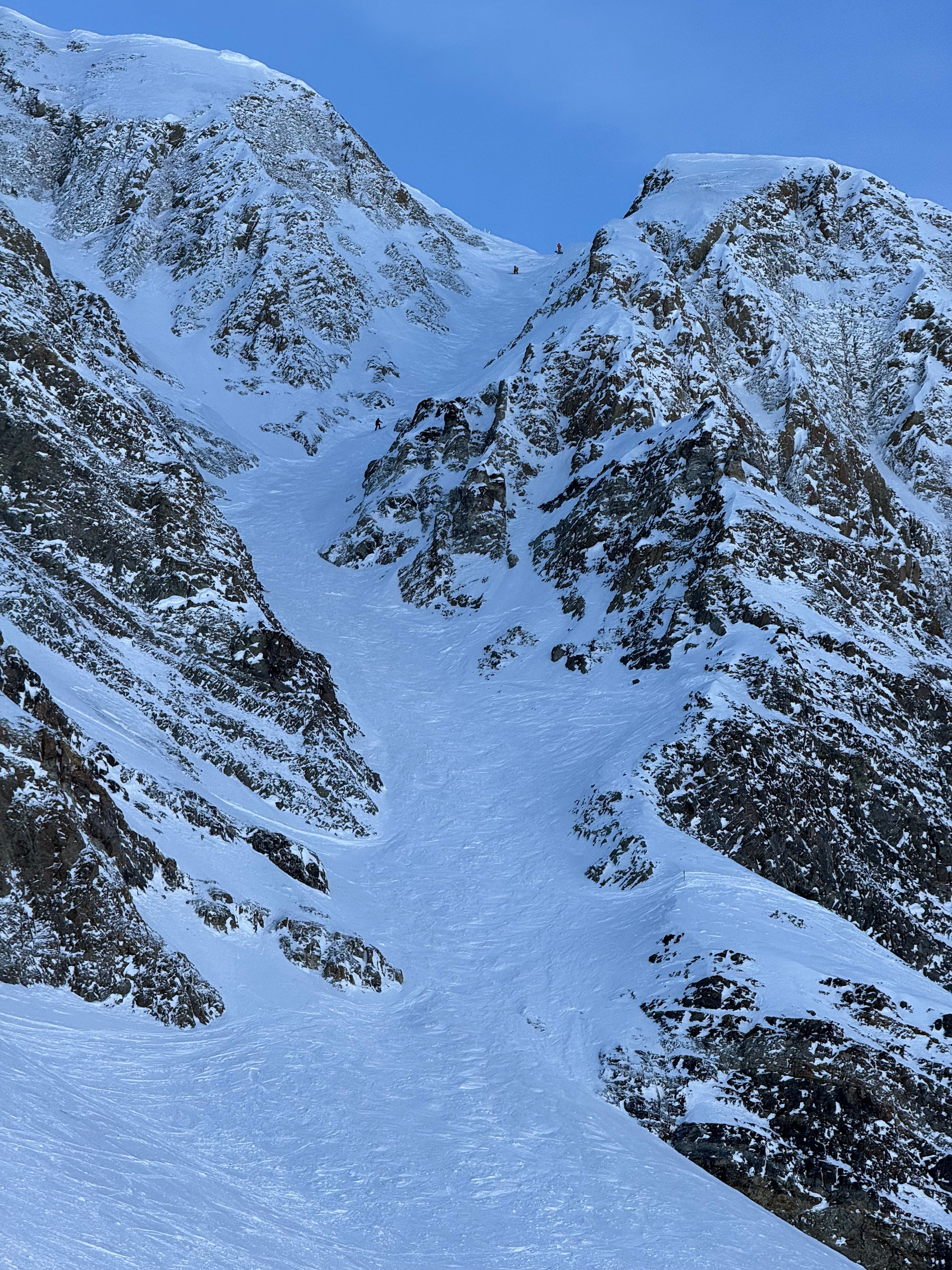
On the five minute chairlift up Powder Seeker, you’re forced to stare directly at her. And she teases me. She sits skier’s left of Lone Peak, an eleven thousand foot tall traffic cone that towers over the surrounding skiable terrain. From the peak, there’s a narrow chute that descends back down into the skiable terrain below. It’s called the Big Couloir. It’s an iconic line and perhaps one of the most difficult lines of skiable terrain on piste. And every year, the Big asks me the same question: “Today”?
Within our friend group that goes to Big Sky every year, there’s a running joke (or at least I think it’s been a joke). As the group text gets active before the trip, inevitably the big question that I get to check off in the free space of the Big Sky bingo card each year is “Should we ski the Big?”
For many years, that comment was made in jest. We are just a couple dudes that love to get together and ski (safely). Ten years ago, I barely skied a handful of days a year. I had always wanted to to be someone who could ski two dozen times a season (at least) but for most of my life it wasn’t a core part of my identity, so it was just a dream. But slowly, I’ve made it more of a priority. I’ve planned more days each year. I got into backcountry skiing. I started to climb uphill to difficult lines that push me out of my comfort zone.
I’ve reached another impasse in my life journey and it feels important to stop and ponder. Do I accept that I will just be a “half day to apres” skier? Casual, enjoyable, and yet predictable. Or do I push my boundaries and my limits, and embrace the challenge of reaching new heights (literally)? I thought as I got older, it would become clear to me that, despite my longing and mouth gaping looks at the Big each year, my desire for the challenge would dissipate. My body would be less up to the challenge, and slowly, my stubborn mind would accept that our future would be to lap Mr. K on repeat. That’s not a failure, it’s just a different future. But until I choose a path, challenge or acceptance, I sit with a foot in both camps wondering what my future holds, and there I stagnate.
I want to be abundantly clear. I don’t particularly enjoy standing at the top of exposed peaks, in the wind, looking at what’s underneath me. It gives me the heebie jeebies. I can quite literally feel my inner voices of safety and security screaming “Nope, Nope, Nope. GET ME OFF” But each time I do it, I feel a sense of accomplishment and gratitude. And in doing hard things, I have grown.
The reality, though, is that it is far easier to imagine a future in which I’ve successfully skied the Big, than to picture myself standing at the top, with the wind howling in my face, staring straight down the line below, heart in mouth, looking directly at that first turn, which needs to be executed to perfection without hesitation. It is easier for me to envision “one day” than to confront my fear and to accept challenge head on.
I advise people on risk for a living. This is an obviously avoidable risk. If I don’t ever ski the Big, I avoid fear of failure, I avoid injury, I avoid that inner feeling screaming at me at the top to “get me the f— down.” But what growth or life am I trading off for that safety? What are we giving up in our lives for predictability and comfort? How much life do we miss when we can imagine a future of more, and yet, we continue on a life of comfortable habits and predictable circumstances because the status quo is the easier choice. We often settle for imagining the version of ourselves who did the thing, because actually becoming that person requires confronting fear and uncertainty.
That is not to say that choosing not to ski the Big, or to start a business, or to take a sabbatical is the wrong choice. But it is a choice. I have to say that it’s not for me. And all that energy I give envisioning myself skiing the Big can now be redirected to other pursuits. I can move forward. Maybe the reality is that it would be difficult to leave a corporate job because it puts a family’s needs at risk. That may be a dream that needs to be deferred. But choosing to say “this is not the time” allows us to move forward in a way that “one day” does not.
So where do I go from here? What version of myself should I be loyal to? The boy that craves safety and security, but might have missed out on the intensity and accomplishment that life has to offer to those that choose to enter the arena. Or do I chase the next high? And at what point does my desire to accomplish more fall in to reckless abandon?
What I sit and grapple with is this thought of “I’ll know when it’s time” or “I will do it some day.” And that is precisely the way of thinking that ensures I never make a choice to act, while I wait from a divine sign from the universe to tell me what to do next. We become destined for a life of living in limbo. Caught in between two ideas, two identities, and we can envision a future of both. But so long as I sit in limbo, I’ll look at that line every year that I don’t ski it and wish I did. I can imagine a future in which I’ve done it. And that imagined future feels like a sense of accomplishment in and of itself. And yet, my inaction does not point me in the direction of becoming that person.
I’ve come to realize I don’t need to ski the Big to feel a sense of accomplishment. I don’t need to conquer the next mountain. But I cannot continue to tell myself that I will do it one day, and imagine the future in which I had. Because that is not my reality. My choice is not to ski the Big tomorrow, but is to act in a direction that says “I’m going to do this” or that says thank you for allowing me to imagine that future, but it is not for me, and to say goodbye.
On my last ride up Powder Seeker this year, there was the Big. We had a long talk without saying much of anything. And as she often does, she asked “today?”
Not today.
Your column today reminds me of one of my all-time fave scenes in a movie: From the Wild Bunch. With their companion Angel being captured and tortured by General Mapache, William Holden has finally taken enough, so he walks in Warren Oates (who is passing time with a young woman) and says “let’s go”. Warren Oates looks at him, smiles, and says “why not!” And thus begins perhaps Sam Peckinpah’s most cinematic and violent filming.